Why Physical Notebooks Might Be Slowing Down Your Novel Writing Progress
Why Physical Notebooks Might Be Slowing Down Your Novel Writing Progress
Within certain writing subcultures, the myth that using pen and paper produces the best results has taken hold. It may be the case that a pen and a notebook are the best tools for the job when one is just getting started on a piece, but once you are 30,000 words in, the expense of running…
The transcription tax nobody talks about
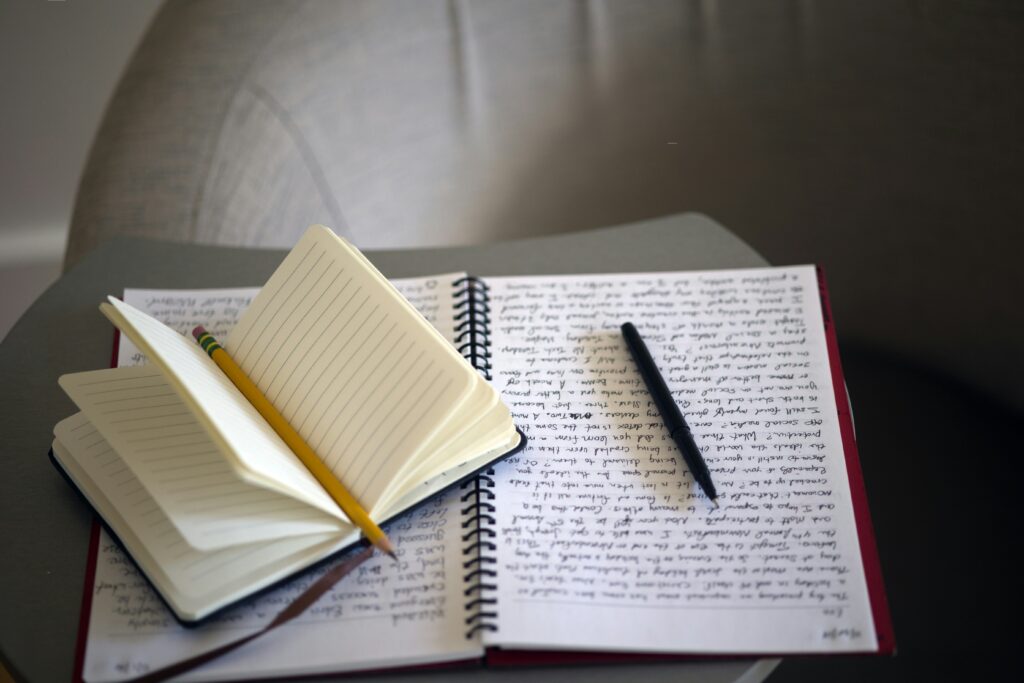
Writing by hand certainly has its benefits. It’s been shown to improve memory, spark creativity, and even make you healthier, since writing requires fine motor skills that engage the brain. However, the same argument could probably be made for knitting or calligraphy or surgery, and we don’t perform those activities in lieu of making our manuscripts.
Handwriting feels like so much more than typing. And maybe it is. But what it’s not is writing. Not in a modern publishing sense. It’s drafting. It’s an extra layer between your brain and the reader’s brain – which is fine if you love that layer, but unnecessary if what you really care about is the words themselves.
When memory and momentum collide
Think about the vast amount of mental energy it takes to create a coherent world and fill it with characters who each have their own agenda. Not to mention crafting a plot that keeps readers turning pages! This is complicated, detailed work that requires immense focus.
Now, imagine you’re knee-deep in this world, juggling everything and feeling the flow of your story, when you have to suddenly stop and go back a few pages to check some specific detail. You then lose your flow, your connection to the story weakens, and it takes time to immerse yourself in it again. This is not efficient or conducive to creativity.
On the other hand, using a digital writing tool allows you to instantly search for and find whatever detail you need within seconds. This way you can quickly check your character’s eye color and seamlessly continue writing. This helps you stay in your creative bubble and maintain that all-important flow.
The structural editing problem
Mapping out and reorganizing a novel on paper is honestly quite hard. Sure, you can draw arrows between scenes, put down sticky notes, or rewrite the list of chapters on a different sheet of paper, but there’s no neat way to shift a chapter from six to three without it turning into a mess.
A dedicated https://storyloft.app/ platform earns its keep right here. Instead of attempting to force a word processor into acting like a story organizer, the right tool gives you one window where your outline, character summaries, world notes, and manuscript are all there together. You move scenes with a drag, reference a character sheet right there and then, and see your whole story’s progress in one place rather than guessing how you’re doing from memory.
Scatterbrain syndrome and the myth of the organized notebook
Writers using notebooks tend to generate an abundance of unlinked notes. This is because there’s no "see also" link. With a notebook, it’s hard to embed a clickable character reference, trigger plot definitions, or create a backlink or a dynamic lookup of your most recent notes on the romantic subplot.
While it’s possible to be meticulous and keep a table of contents for your drafts – it amounts to manual, exhausting labor. More often than not, it’s outdated the moment you write your next note. And it doesn’t help at all with dynamically linked content.
And finally, from a creative perspective, notebooks have an inertia problem. Flipping back and forth through a physical journal feels quite different from clicking to a new page in the editor. It can be a wonderful experience in many ways, but it doesn’t support the kind of brainstorming flow you might come to take for granted when you can launch a new pad of virtual paper at the speed of thought.
The risk you probably haven’t fully priced in
Physical notebooks are vulnerable to certain potential mishaps. Water spills, fires, a bag left on a train – such incidents can abruptly terminate hours of your hard work. There’s no version history, no cloud backup, no automatic save every thirty seconds. The threat is considered rationally by most people familiar with physical notebooks, but we don’t engage it before we have to. Most digital writing environments solve backup passively.
What you actually lose by going digital
To be honest, there’s not much that can’t be preserved. If the physical act of writing is important to you – the pen, the notebook – reserve that for journaling, for a.m. free-writing, for early ideation. Those are good habits. The problem is when you take those habits into the long-term drafting and note-keeping aspects of a project, for which a computer is inherently better suited (and necessity for searchability and organization alone demands its use).
None of this is about writing differently. It’s about not allowing your tools to unconsciously work against you at the precise phase of your project in which you have to work the hardest.